Custom drive systems when off-the-shelf doesn't fit.
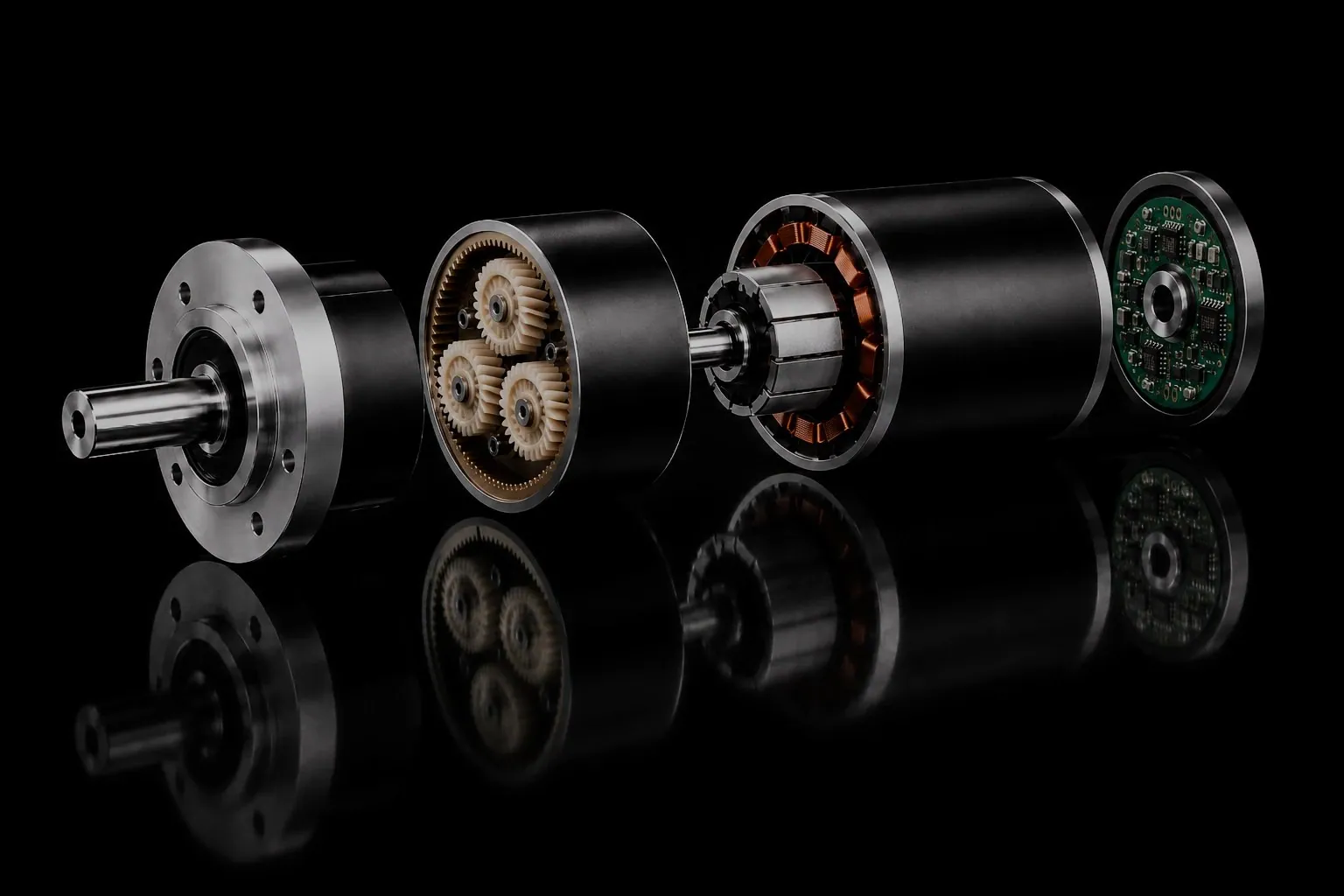
Motor, gearbox, sensing and electronics engineered as one system — developed in Austria and delivered ready for series.
Motor, gearbox, sensing and electronics engineered as one system.
One drive system. One engineering decision. We do not select four components and hope they match — the architecture is decided as a whole.
BLDC and DC motor design and selection
Planetary, spur, worm and custom gear systems
Hall, encoder and position feedback
Drive electronics and control integration
When standard drives stop fitting the product.
Standard components are usually selected around nominal ratings. The real product, however, is defined by its actual boundary conditions.
- Torque-speed trajectory
- Duty cycle
- Installation space
- Thermal limits
- Acoustic requirements
- Lifetime
- Energy budget
- Target cost
DRIVS engineers the drive around the application — not around a catalogue part.
How we engineer a drive.
Engineering from the operating point — five steps from the first requirement to a drive that can be built in series.
-
01
Understand the load
Torque · Speed · Duty cycle · Ambient conditions · Lifetime · Available installation space
-
02
Define the architecture
Motor · Gearbox · Sensing · Electronics · Mechanical interfaces
-
03
Optimize the system
Efficiency · Thermal behaviour · Noise · Package · Energy consumption · Target cost
-
04
Validate the design
Calculation · Simulation · Prototype · Testing · Iteration
-
05
Industrialize
Supplier qualification · Tooling · Quality planning · Series preparation · Production transfer
A new drive, a better version of the one you have, or the parts to build it.
Custom Drive Engineering
A complete drive developed around your operating point — motor, gearbox, sensing and electronics designed and validated as one system, then taken into series.
Custom Drive Engineering →Cost-Down Engineering
Improve the drive architecture while maintaining or improving technical performance — teardown, benchmarking, design simplification, validation.
Cost-Down Engineering →Drive Component Sourcing
We select the manufacturing partner around the technology, volume and quality requirements of the product.
Drive Component Sourcing →Engineering beyond the nameplate.
The rating that matters is not the headline power figure. A drive has to work at the real operating point — including duty cycle, temperature, efficiency, lifetime and gearbox ratio.
Two motors with the same nameplate power can behave completely differently once the duty cycle, the thermal path and the gear ratio are taken into account. That is where the drive is decided.
Applications we engineer for.
Application fields for custom drive systems — shown as the kind of products we engineer for, not as completed customer projects.
We engineer. Our network builds. We deliver.
You keep one technical contact from the first requirement to series delivery. The supply chain stays our job.
- Requirements
- Drive architecture
- Calculation
- Engineering
- Supplier selection
- Technical coordination
- Validation
- Quality
- Customer interface
- Motor manufacturing
- Gear manufacturing
- Winding
- Machining
- Electronics
- Tooling
- Assembly
- Series production
One partner. One point of contact from requirement to series — you never coordinate the supply chain yourself.
Engineered and managed in Austria. Manufactured by qualified partners. Delivered and supported by DRIVS.

Built from experience. Created for a better way of developing custom drives.
DRIVS is a new company built on years of hands-on experience in product development, drive technology and industrialization. Standard motors often do not fit the product. Large manufacturers are built around standard ranges and high volumes. Engineering offices rarely take supply responsibility. Distributors deliver components, not systems.
DRIVS closes that gap: engineering, industrialization and supply from one partner — and you talk to the engineer responsible for your drive, not to a sales layer.
About DRIVS →
Let's talk about your application.
Tell us the operating point, the installation space and the target cost — we will come back with an engineering answer, not a catalogue page.